
+33 (0)7 87 87 27 79 contact@science-saved.com

2nd Head of Business Development at ESRF (The European Synchrotron)

Very pleased to be hosting the “CAROTS” (www.carots.eu) network today at ESRF – The European Synchrotron and ILL – Institut Laue Langevin. The project is building a network of intermediaires, like NOVITOM, XPLORAYTION GmbH and SARomics Biostructures AB which help bridge between our amazing Large-Scale European Research Infrastructures and industry, supporting industrial R&D using the exceptional properties of these infrastructures.
 
EU_RIs synchrotrons Xrays neutrons
 
Bernhard Hesse
Jakob Øster
Jacob Becker-Christensen
Selma K.
Solveig Hvidtfeldt
Uwe Sassenberg
Nikolaj Zangenberg
Grethe Jensen
Barbara Fayard
Caroline Boudou
Sophie Bouat
Derek Logan
Thomas Schumann


2nd Head of Business Development at ESRF (The European Synchrotron)

SYNERGI 2019 à Lyon

SYNERGI est un événement qui vous donne un aperçu des techniques de caractérisation neutroniques et synchrotroniques pour la R&D. Il présente des techniques qui permettent d’étudier les matériaux et les dispositifs bien au-delà des capacités des laboratoires conventionnels.

  • Génie chimique et catalyse
  • Alimentation, agriculture et produits de consommation
  • Biochimie et développement pharmaceutique
  • Pétrochimie et gaz
  • Chimie de l’environnement

Les neutrons détectent les obstructions dans les pipelines

conference for research with synchrotron radiation, neutrons and ion beams at large facilities

Deux membres du réseau MIXN ont présenté leur impact en tant que “Scientific Service Companies” (SSCs) en apportant leurs compétences de haut niveau à la recherche industrielle et au développement des activités industrielles.

A la conference SNI à Berlin en Septembre 2022, Sophie Bouat (de Science SAVED) et Simon Jacques (de FINDEN) étaient tous deux conférenciers dans le « Microsymposium : Industrie, innovation et transfert » de cette conférence scientifique pour la  recherche avec des radiations synchrotron, des faisceaux de neutrons et d’ions dans les grandes infrastructures de recherche.
Ils ont souligné dans leurs présentations “What do large-facilities bring to industry?” et “Lubricating Industrial Science”, comment les SSCs peut favoriser le transfert de technologie et soutenir les grandes entreprises en résolvant des questions délicates avec des propriétés complexes de matériaux de haute technologie.

Les deux SSCs ont appliqué des méthodes uniques de caractérisation des matériaux en utilisant des neutrons ou des rayons X synchrotron, qui ne sont disponibles que dans les grandes infrastructures de recherche.

SYNERGI 2019 – Lyon

SYNERGI is an event that gives you an insight into neutron and synchrotron characterisation techniques for R&D, introducing techniques that allow materials and device investigation far beyond conventional laboratory capabilities. 
• Chemical engineering and catalysis 
• Food, agriculture and consumer products 
• Biochemistry and pharmaceutical development 
• Petrochemicals & gas 
• Environmental chemistry

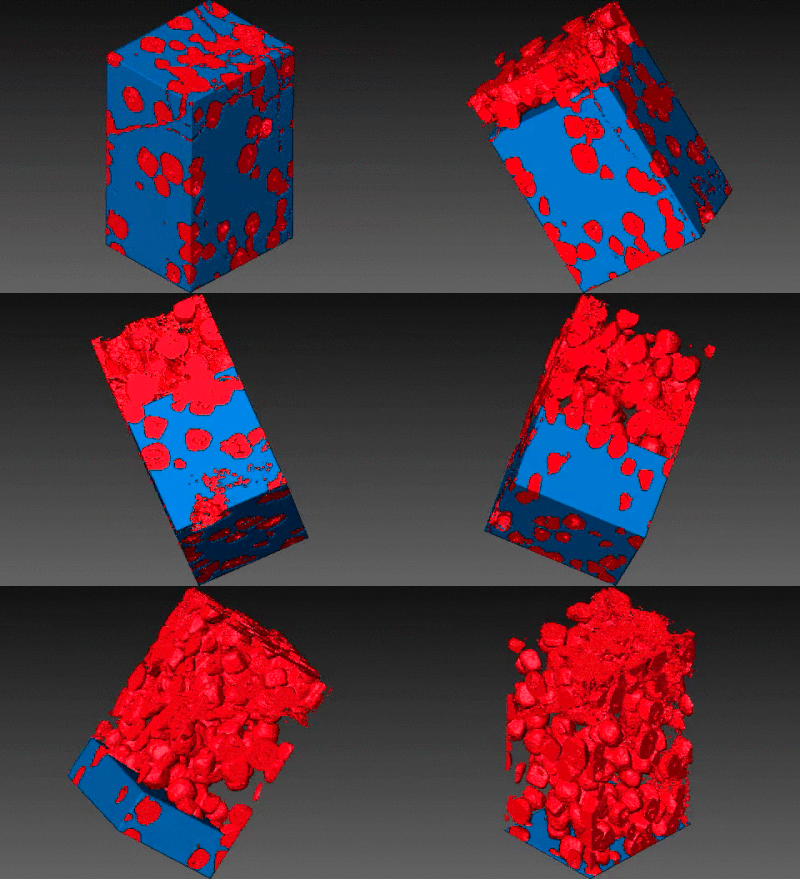
X-ray microtomography

X-ray microtomography, like tomography and x-ray computed tomography, uses x-rays to create cross-sections of a physical object that can be used to recreate a virtual model (3D model) without destroying the original object. The prefix micro- (symbol: µ) is used to indicate that the pixel sizes of the cross-sections are in the micrometre range. These pixel sizes have also resulted in the terms high-resolution x-ray tomographymicro–computed tomography (micro-CT or µCT), and similar terms. Sometimes the terms high-resolution CT (HRCT) and micro-CT are differentiated, but in other cases the term high-resolution micro-CT is used. Virtually all tomography today is computed tomography.

X-ray microtomography

Micro-CT has applications both in medical imaging and in industrial computed tomography. In general, there are two types of scanner setups. In one setup, the X-ray source and detector are typically stationary during the scan while the sample/animal rotates. The second setup, much more like a clinical CT scanner, is gantry based where the animal/specimen is stationary in space while the X-ray tube and detector rotate around. These scanners are typically used for small animals (in vivo scanners), biomedical samples, foods, microfossils, and other studies for which minute detail is desired.

The first X-ray microtomography system was conceived and built by Jim Elliott in the early 1980s. The first published X-ray microtomographic images were reconstructed slices of a small tropical snail, with pixel size about 50 micrometers.